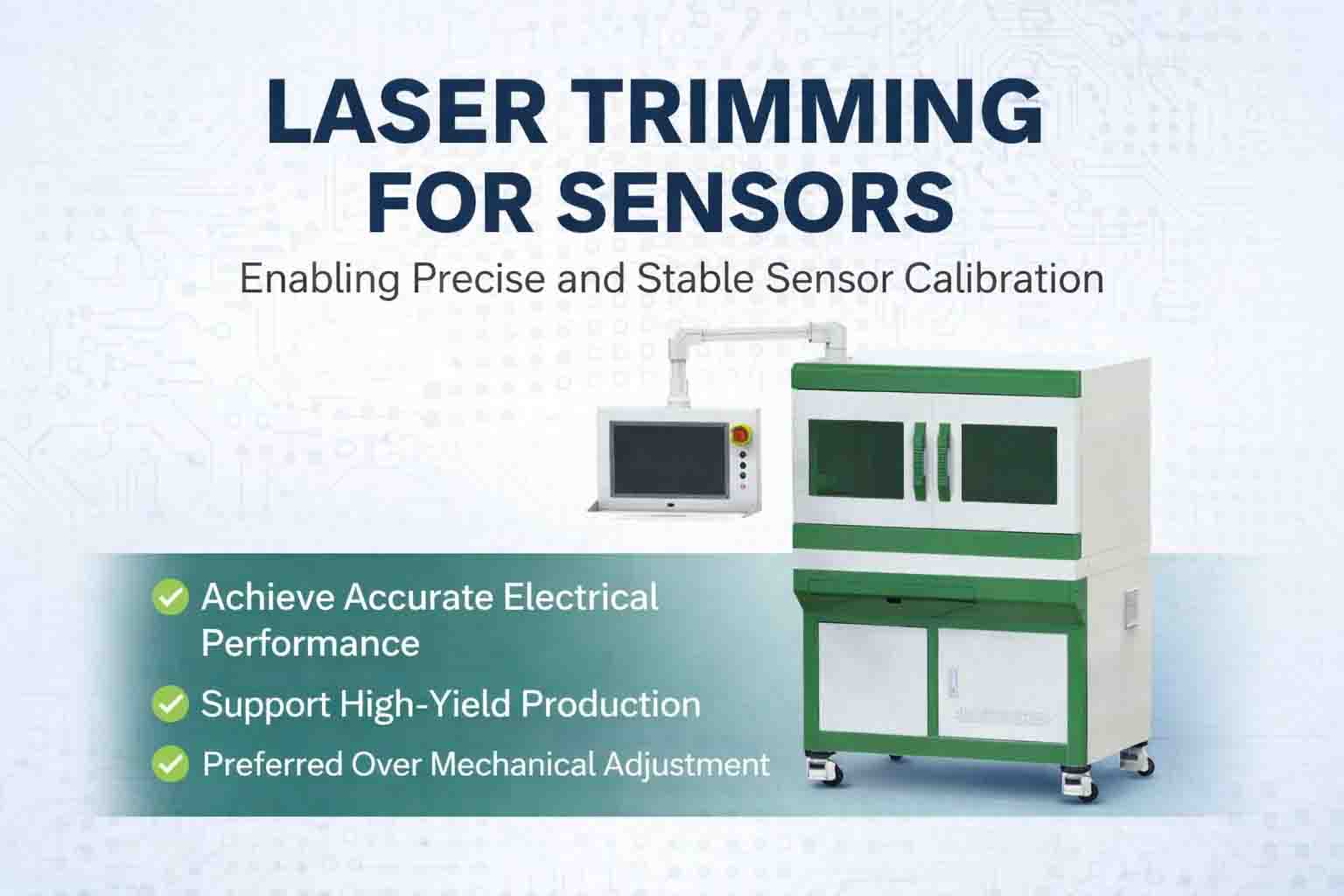
The Growing Importance of Laser Trimming for Sensors
In modern electronics manufacturing, laser trimming for sensors has become an essential process for achieving accurate electrical performance and long-term product stability. As sensor applications continue expanding in automotive systems, medical devices, industrial automation, and consumer electronics, manufacturers increasingly rely on laser trimming for sensors to fine-tune resistance values and improve signal consistency.
Compared with traditional adjustment methods, laser trimming for sensors offers non-contact processing, high repeatability, and micron-level control, making it ideal for sensitive electronic components.
How Precision Trimming Sensors Improves Measurement Accuracy
Modern precision trimming sensors require extremely stable electrical parameters to ensure reliable output under changing environmental conditions. During production, even slight resistance deviation can affect sensor sensitivity, temperature compensation, and calibration accuracy.
Using precision trimming sensors technology allows manufacturers to:
- Adjust resistor values with micron precision
- Improve signal stability
- Reduce calibration errors
- Increase production consistency
- Extend product lifespan
Because of these benefits, precision trimming sensors processing is widely adopted in high-end sensor production.
Why Laser Trimming for Sensors Is Preferred Over Mechanical Adjustment
Traditional mechanical trimming methods often introduce stress, contamination, or inconsistent adjustment results. In contrast, laser trimming for sensors uses highly controlled laser energy to remove resistor material precisely without physical contact.
Advantages of laser trimming for sensors include:
- No mechanical damage
- High-speed processing
- Excellent repeatability
- Suitable for microelectronic structures
- Easy integration with automated production lines
This makes laser trimming for sensors especially suitable for high-volume manufacturing.
Precision Trimming Sensors in Automotive and Industrial Applications
Today, precision trimming sensors are widely used in industries where accurate data collection is critical. Automotive pressure sensors, temperature sensors, and flow sensors all depend on precise resistor calibration during production.
Typical applications of precision trimming sensors include:
- Automotive pressure sensors
- Temperature compensation circuits
- Medical sensing modules
- Industrial measurement systems
- Smart electronic devices
High-quality precision trimming sensors directly improve final product reliability.
Laser Trimming for Sensors Supports High-Yield Production
A major advantage of laser trimming for sensors is compatibility with automated manufacturing systems. Modern laser trimming equipment can integrate directly with electrical testing systems to perform automatic adjustment based on real-time feedback.
This allows manufacturers to improve:
- Production yield
- Process stability
- Labor efficiency
- Calibration accuracy
As a result, laser trimming for sensors has become a core process in precision electronics manufacturing.
Why Overseas Buyers Focus on Precision Trimming Sensors Technology
International buyers selecting trimming equipment often evaluate whether precision trimming sensors solutions can meet strict industrial standards.
Main purchasing concerns include:
- Trimming accuracy
- Laser stability
- Software control capability
- Production speed
- Technical support
Suppliers offering stable laser trimming for sensors solutions often gain stronger competitiveness in global markets.
Future Demand for Laser Trimming in Sensor Production
As smart manufacturing and intelligent sensing technologies continue to expand, the demand for laser trimming for sensors will continue growing worldwide. More advanced precision trimming sensors production requires increasingly accurate resistor adjustment systems.
For sensor manufacturers seeking long-term production stability, laser trimming technology remains one of the most reliable solutions.