Understanding Thin Film Laser Trimming in Modern Electronics
Thin film laser trimming is widely used in high-precision resistor manufacturing because it allows extremely accurate resistance adjustment with minimal thermal impact. Thin film resistors are usually produced by depositing a very thin resistive layer onto ceramic or glass substrates, and laser trimming precisely removes small portions of this layer to achieve target resistance values.
Compared with traditional adjustment methods, thin film laser trimming offers excellent repeatability, micron-level precision, and stable long-term electrical performance. This technology is commonly used in aerospace electronics, medical devices, automotive sensors, and semiconductor circuits where resistance tolerance must be tightly controlled.
The biggest advantage of thin film laser trimming is that it supports very fine trimming paths, allowing manufacturers to achieve ultra-low tolerance values such as ±0.01% or even better.
What Is Thick Film Trimming and Where Is It Used
Thick film trimming is used for resistor networks and electronic components where the resistive material layer is thicker and usually screen-printed onto ceramic substrates.
Because thick film resistors contain a larger resistive layer, thick film trimming often focuses on balancing production efficiency and resistance correction rather than extreme ultra-high precision.
Typical applications of thick film trimming include:
- Industrial control circuits
- Consumer electronics
- Automotive modules
- Power electronics
- Sensor modules
Compared with thin film systems, thick film trimming is generally more cost-effective for large-volume production.
Core Difference Between Thin Film Laser Trimming and Thick Film Trimming
The main difference lies in material structure and trimming precision.
Thin Film Laser Trimming Features
- Extremely thin resistive layer
- Higher trimming accuracy
- Better temperature stability
- Lower noise performance
- Suitable for precision circuits
Thick Film Trimming Features
- Thicker resistive paste layer
- Higher production efficiency
- Lower manufacturing cost
- Suitable for standard industrial applications
In practical production, thin film laser trimming is selected when electrical precision is critical, while thick film trimming is preferred when cost and output volume are the main priorities.
Accuracy Comparison: Thin Film Laser Trimming vs Thick Film Trimming
For high-end resistor production, thin film laser trimming clearly provides superior accuracy.
Typical achievable tolerance:
- Thin film laser trimming: ±0.01% to ±0.1%
- Thick film trimming: ±0.1% to ±1%
Because the trimming depth control in thin film laser trimming is finer, the final resistance stability is often better over long-term operation.
This is especially important in:
- Medical electronics
- Aerospace systems
- High-frequency communication devices
- Precision instrumentation
Production Cost Comparison
From a production cost perspective, thick film trimming often has lower overall cost because the base resistor fabrication process is simpler.
However, thin film laser trimming creates higher product value in applications where premium performance is required.
Thick Film Trimming Cost Advantages
- Lower raw material cost
- Faster batch production
- Lower unit price
Thin Film Laser Trimming Value Advantages
- Premium resistance accuracy
- Higher reliability
- Better product consistency
Laser System Requirements for Thin Film and Thick Film Trimming
Both technologies require stable laser trimming systems, but parameter settings differ significantly.
For thin film laser trimming, laser systems usually require:
- Smaller focused spot
- Higher motion precision
- Fine pulse energy control
For thick film trimming, systems focus more on:
- Stable trimming speed
- Production throughput
- Repeatable resistance correction
A professional trimming system should support multiple trimming patterns such as:
- L-cut
- Serpentine cut
- Double-sided trim
- Adaptive trimming path
Which Industries Prefer Thin Film Laser Trimming
Thin film laser trimming is widely used in:
- Precision resistor manufacturing
- Medical electronics
- Aerospace circuits
- Semiconductor packaging
- Advanced sensors
Which Industries Prefer Thick Film Trimming
Thick film trimming remains highly popular in:
- Automotive electronics
- Household appliances
- Power control modules
- Industrial sensors
- Consumer electronics
How to Choose the Right Laser Trimming Solution
If your production requires ultra-high electrical precision, thin film laser trimming is usually the better choice.
If your focus is cost control and large-volume output, thick film trimming may offer better overall efficiency.
Many global manufacturers now combine both technologies depending on product category.
Why Professional Laser Trimming Equipment Matters
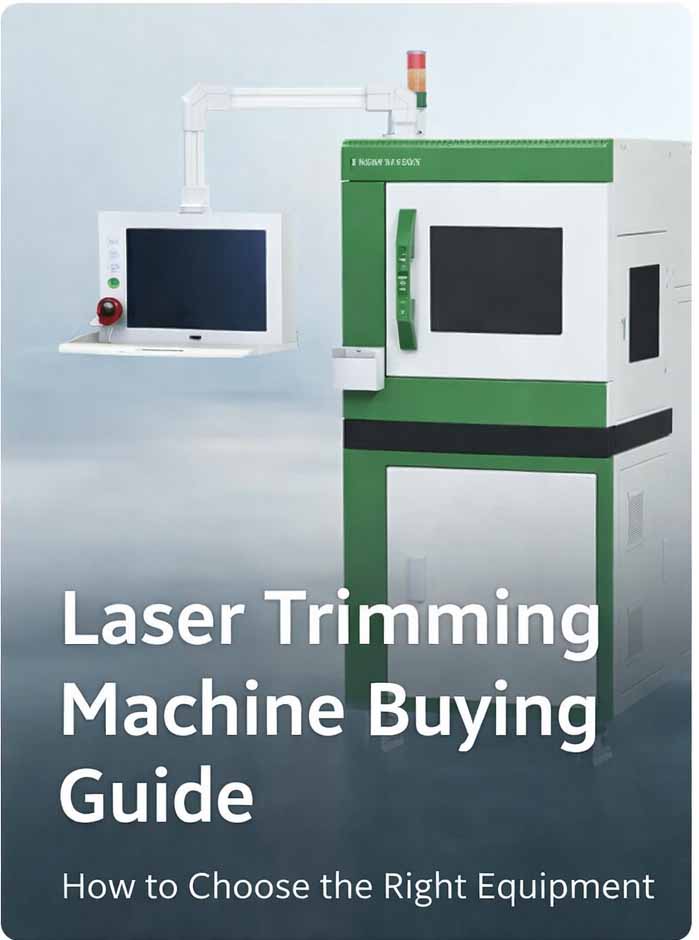
Whether for thin film laser trimming or thick film trimming, machine stability directly affects final resistor quality.
A reliable laser trimming solution should provide:
- Stable laser power
- Precision motion control
- Real-time resistance monitoring
- Flexible trimming software
- Long-term process consistency
Request Advanced Laser Trimming Solutions
If you are looking for professional equipment for thin film laser trimming or thick film trimming, selecting an experienced supplier helps improve production quality and long-term manufacturing stability.
A high-performance trimming system helps manufacturers achieve:
- Better trimming precision
- Lower rejection rate
- Higher production efficiency
- Stable long-term electrical performance