How to Improve Resistance Accuracy by Laser Trimming
Introduction
In modern electronics manufacturing, achieving high resistance accuracy is critical for ensuring product performance, stability, and reliability. From automotive electronics to medical devices, even slight deviations can lead to system inefficiencies or failures. This is where precision resistor adjustment through laser trimming becomes an essential technology. By integrating advanced laser systems into production lines, manufacturers can significantly improve resistance accuracy and meet strict industry standards.
What is Laser Trimming?
Laser trimming is a highly precise process used to adjust the resistance value of electronic components by removing small portions of resistive material. This method enables fine control over resistance accuracy without physically damaging the component. Compared to traditional trimming techniques, precision resistor adjustment via laser offers superior consistency, speed, and repeatability, making it ideal for high-volume manufacturing environments.
Why Resistance Accuracy Matters
High resistance accuracy directly impacts the performance of electronic circuits. In applications such as sensors, amplifiers, and power management systems, even minimal resistance variation can cause signal distortion or energy loss. Through precision resistor adjustment, manufacturers can ensure that each component meets exact specifications, resulting in improved product quality and reduced failure rates.
Key Benefits of Laser Trimming
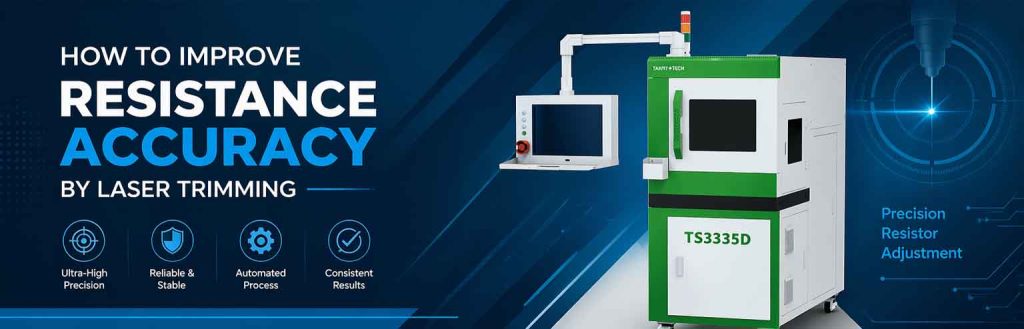
- Ultra-High Precision
Laser trimming allows extremely fine precision resistor adjustment, achieving tight tolerance levels and exceptional resistance accuracy. - Non-Contact Process
As a non-contact method, it minimizes mechanical stress, preserving component integrity while enhancing resistance accuracy. - Automation Capability
Fully automated systems enable consistent precision resistor adjustment across large production volumes. - Cost Efficiency
By reducing material waste and rework, laser trimming improves manufacturing efficiency while maintaining optimal resistance accuracy.
Laser Trimming Process Explained