Fiber Laser vs UV Laser for Resistor Trimming: Which Is Better?
Introduction
In modern electronics manufacturing, fiber laser trimming and UV laser trimming have become essential technologies for achieving high-precision resistor calibration. As demand for accuracy and stability increases in industries such as automotive electronics, medical devices, and communication systems, choosing the right trimming solution is critical. This article compares fiber laser trimming and UV laser trimming to help you select the best solution for your production needs.
What Is Laser Trimming?
Laser trimming is a process used to precisely adjust the resistance value of resistors by removing a small portion of resistive material using a focused laser beam. Both fiber laser trimming and UV laser trimming offer non-contact, high-precision solutions, but they differ significantly in performance, material compatibility, and cost.
Fiber Laser Trimming: Efficient and Cost-Effective
Key Features of Fiber Laser Trimming
- High efficiency and fast processing speed
- Excellent for thick film resistors
- Lower operating and maintenance costs
- Long laser lifespan
Fiber laser trimming uses infrared wavelengths, making it ideal for applications where speed and cost-effectiveness are priorities.
Applications of Fiber Laser Trimming
- Thick film resistor trimming
- General electronics manufacturing
- Automotive components
- Industrial control systems
If your production focuses on volume and efficiency, fiber laser trimming is a reliable choice.
UV Laser Trimming: Ultra-High Precision Solution
Key Features of UV Laser Trimming
- Short wavelength for higher absorption
- Minimal heat-affected zone
- Extremely high precision and accuracy
- Ideal for sensitive materials
UV laser trimming is known as a “cold processing” method, which reduces thermal damage and ensures superior trimming quality.
Applications of UV Laser Trimming
- Thin film resistor trimming
- Precision electronics and semiconductors
- Medical devices
- High-end circuit boards
For applications requiring extreme precision, UV laser trimming is the preferred solution.
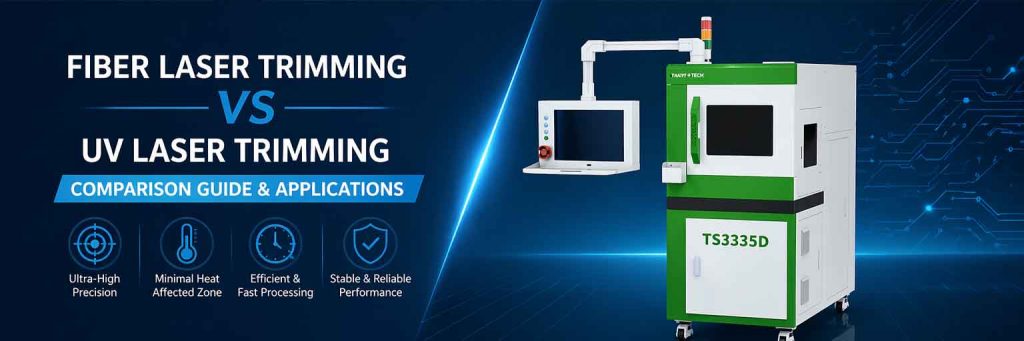
Fiber Laser Trimming vs UV Laser Trimming
| Feature | Fiber Laser Trimming | UV Laser Trimming |
|---|---|---|
| Wavelength | Infrared | Ultraviolet |
| Precision | High | Ultra-high |
| Heat Impact | Moderate | Minimal |
| Speed | Faster | Slightly slower |
| Cost | Lower | Higher |
| Best For | Thick film resistors | Thin film resistors |
How to Choose the Right Laser Trimming Solution
When selecting between fiber laser trimming and UV laser trimming, consider:
- Resistor Type: Thick film → fiber / Thin film → UV
- Precision Requirement: Standard vs ultra-precise
- Production Volume: Mass production vs high-end applications
- Budget: Initial investment vs long-term ROI
Why Laser Trimming Matters for Your Business
Both fiber laser trimming and UV laser trimming improve:
- Product accuracy and consistency
- Circuit performance and reliability
- Production efficiency
- Yield rate in electronics manufacturing
By investing in the right trimming technology, manufacturers can significantly enhance product quality and competitiveness.
Conclusion
Choosing between fiber laser trimming and UV laser trimming depends on your specific application needs. If you prioritize speed and cost-efficiency, fiber laser trimming is the ideal solution. However, for ultra-high precision and minimal thermal impact, UV laser trimming stands out as the best choice.
Get a Quote Now
Looking for a reliable fiber laser trimming or UV laser trimming solution?
Contact us today to get customized resistor trimming systems designed for your production line. Boost precision, improve yield, and grow your business with advanced laser technology!